The Escape

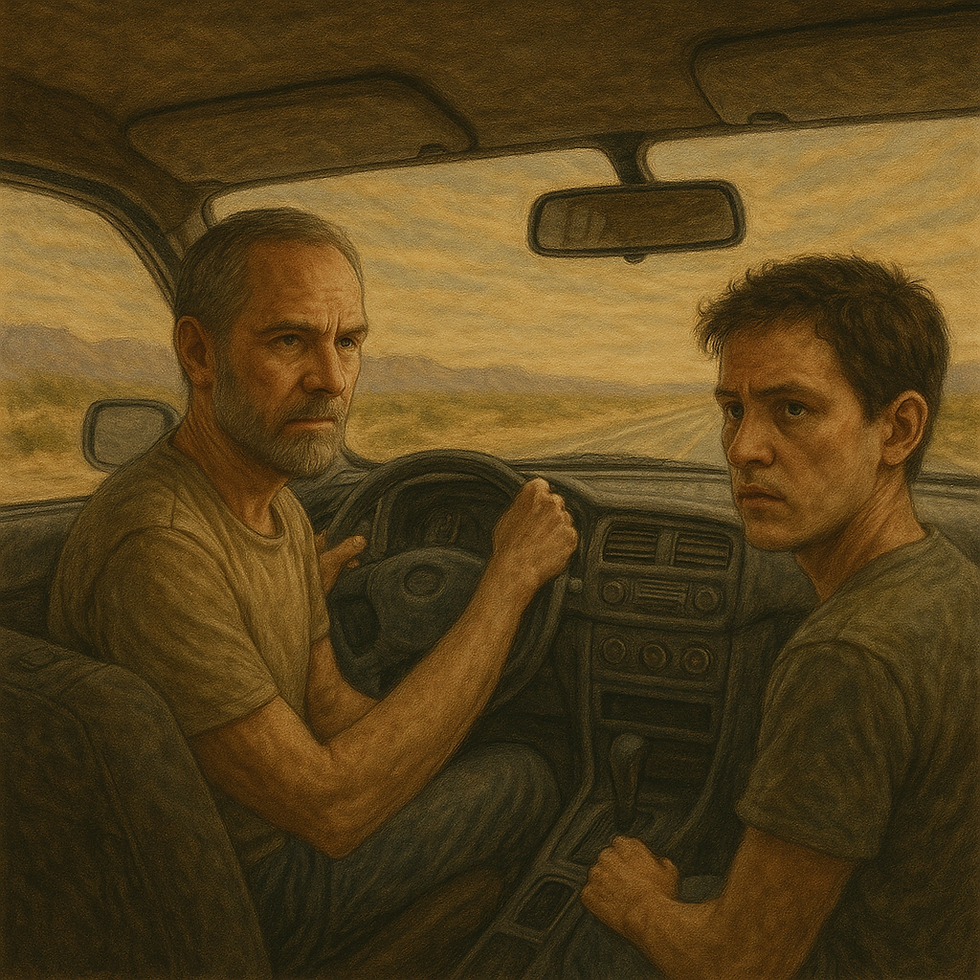
Part One: Flight Across the Desert
The highway stretched like a black ribbon through the desert night, its edges swallowed by sand and silence. The sky above was vast and endless, a black sea dusted with stars so sharp they looked like shards of crystal hammered into the firmament. The car’s headlights carved out a narrow tunnel of pale gold, chasing away shadows that gathered and folded again as soon as they passed. Sagebrush blurred at the periphery, their shapes ghostlike in the dim light, while heat still lingered from the day, radiating upward from the asphalt in faint, wavering mirages.
The speedometer needle trembled just shy of ninety, and still Simon pressed harder on the gas. His jaw was clenched, the tendons in his neck taut, his knuckles pale where they gripped the steering wheel. Each mile marker they passed seemed like another barrier broken, another layer between them and the place they had fled. Yet every gust of wind, every faint hum of tires on pavement whispered of pursuit.
Beside him, Aaron shifted restlessly in the passenger seat. He drummed his fingers against his knee, a nervous rhythm that matched the stutter of his heart. His eyes flicked from the dash to the dark road stretching forever forward, then to his brother’s profile—sharp against the shifting light, etched with determination. The silence between them was heavy, full of words neither dared speak.
“You don’t think they’ll follow, do you?” Aaron asked at last, his voice low, as though speaking too loud might call them back. His throat was dry, each word tasting of copper and dust.
Simon didn’t answer right away. The desert wind hissed through a crack in the window, carrying with it the dry taste of alkali and something metallic, almost like blood. He kept his gaze locked on the horizon, where the line between earth and sky blurred in darkness. Finally, he said, “If they are, then we don’t slow down. Not until L.A.” His voice was gravel, tight with resolve.
Aaron swallowed, his Adam’s apple bobbing. He leaned his head back against the seat, feeling the rough fabric scratch his skin. The upholstery smelled faintly of gasoline, sweat, and stale smoke. “It feels strange,” he murmured. “Like… like I left part of myself behind.”
Simon’s mouth tightened. “That’s what they wanted.”
The words dropped like stones into the silence, heavy with memory neither wanted to touch.
Aaron closed his eyes, but the images rose anyway, unbidden and merciless: endless corridors humming with fluorescent light, walls that pulsed faintly as if alive. Faces pale and hollow, eyes glassy with exhaustion, bodies moving in a slow, shuffling rhythm that had nothing to do with life. And always—always—that sensation of something feeding. Not blood. Not flesh. Worse. A siphoning of energy, as though each breath exhaled was captured, each heartbeat drained and catalogued by something unseen. He remembered the feeling of being hollowed out from within, thoughts growing brittle, memories fraying like old fabric.
He shivered and opened his eyes. The stars above seemed brighter now, brilliant and merciless, hard diamonds scattered across the sky. For a moment, he envied their distance, their untouchable purity.
Simon glanced sideways at him, his expression unreadable. “Don’t think about it.”
“How can I not?” Aaron’s voice cracked, the edge of hysteria sharpening it. “I still feel it. Like hands under my skin.” He rubbed his arms fiercely, trying to chase away the sensation. “What if—what if we didn’t escape at all? What if this is just another room, another corridor?”
Simon’s hands tightened on the wheel. The car swerved slightly, then straightened as he forced his grip steady. “Then we break through this one, too.” His voice was steel, low and certain. “We keep moving. We don’t look back. And when we get there—India, the ashram—we remember who we are. That’s the only way.”
Aaron stared at him, at the hard lines etched by exhaustion and resolve on his brother’s face. Simon’s eyes, even shadowed in the dim light, burned with something fierce, unshakable. For all his doubts, Aaron’s fear eased, if only a fraction. His brother’s certainty was a lifeline in a sea of unknowns.
The car roared through the desert, the engine straining, the headlights spilling over empty signs that flashed past too quickly to read. Fences lined the road here and there, broken and rusting, vanishing into the sands. The air inside vibrated with the rhythm of the machine and with something else—a current of urgency, of unfinished fate pressing them forward. The night itself seemed to lean toward them, urging them onward.
Aaron whispered, almost to himself, “Never again. I won’t go back there. I’d rather die.”
Simon finally looked at him, just long enough for Aaron to see the fire in his brother’s eyes. “We won’t,” Simon said. “Not this time.”
The glow on the horizon grew brighter, swelling into a smear of light against the sky. Soon the desert gave way to the ragged edges of suburbs, rows of gas stations, warehouses, and tired motels lit by buzzing neon signs. Billboards rose like skeletal sentinels, advertising fast food and liquor, their colors garish in the night. And then—streets choked with midnight traffic, headlights weaving like restless fireflies.
Los Angeles.
The city rose before them in glass and steel, sprawling endlessly, alive in a way that felt almost alien after the silence of the desert. Skyscrapers glimmered like crystal towers, every window a reminder of countless lives being lived, each oblivious to the war Aaron and Simon carried in their memories. Aaron pressed his face to the glass, half-dazed. “So many people,” he whispered. “Do they have any idea? Any at all?”
Simon shook his head. “Most don’t. Most never will.” His words were not cruel, but heavy with resignation.
The freeway funneled them toward the airport, signs flashing overhead, arrows pointing toward departures. The closer they drew, the heavier the air seemed to grow, a pressure building in Aaron’s chest as though some invisible hand had reached across the miles to squeeze his heart. He pressed his palms against his thighs, trying to steady himself, but the dread only deepened.
Simon must have felt it too—his jaw flexed, his shoulders stiffened—but he didn’t slow. He swung the car into the parking structure, the tires screeching as they rounded the curve. The engine cut abruptly, leaving a ringing silence that made Aaron’s ears buzz.
For a long moment, Simon sat motionless, staring through the windshield at the looming terminal. Light spilled from its windows, travelers moved like shadows beyond the glass, and the air shimmered faintly with jet fuel and anticipation. It was another world, separate from the one they had left behind.
Aaron finally found his voice. “Once we get on that plane… do you think we’ll be safe?”
Simon turned, and for the first time that night, the steel in his eyes softened. “Not safe. But free. Free enough to do what we have to.”
Aaron nodded, though the word “free” tasted strange in his mouth, like a promise too fragile to hold. Still, he pushed the door open, the cool night air rushing in to replace the heavy silence. It smelled of concrete and oil, sharp and grounding.
Together they walked toward the terminal, their footsteps echoing on concrete, each step a heartbeat of defiance. Each carried the weight of what they’d fled and the desperate hope that, across the ocean, something better awaited them.
Neither looked back.
Part Two: The Ashram
The air was thick with incense and the faint sweetness of jasmine that drifted in from the gardens. Dawn’s first light crept slowly into the ashram, pale gold spilling across stone floors polished smooth by decades of bare feet. The walls were bare, save for a single bronze bell that hung above the entrance, and the faint echo of chanting drifted from a nearby courtyard. Beyond the walls, the Himalayas loomed, their snowy crowns touched by the first blush of sunrise.
Inside the meditation hall, silence reigned. The brothers sat cross-legged upon worn cushions, their spines rigid, their bodies lean from years of ascetic practice. They wore simple robes of white cotton, threadbare at the knees, yet clean. Their breaths moved in rhythm with the quiet pulse of the hall, each inhale a gathering, each exhale a surrender.
Twenty years had remade them. Their faces were weathered, their eyes deepened, as if all the years had been spent not only in prayer but in battle with themselves. Simon’s hair, once thick and dark, now carried streaks of silver. Aaron’s hands, always restless in youth, were calloused from endless prayer beads and the repetitive labors of monastic life.
For a long while, the hall seemed to hold them in timeless stillness. Then Aaron’s voice cracked the silence. Softer than it once had been, tempered by practice, but still carrying the old edge of longing. “Do you ever think about it?”
Simon did not open his eyes. His breath remained steady, precise. “About what?”
“The place,” Aaron said, his voice catching. “The prison. The corridors. The way it felt.” His fingers tightened around the strand of mala beads coiled in his lap. The beads clicked softly, each one sliding against the next like whispered confessions.
Simon exhaled, the sound slow, deliberate, as if even his sigh was under discipline. “We’ve spoken enough about it.”
Aaron’s lips trembled. He leaned forward, beads slipping faster through his fingers. “But don’t you see? That’s why we’re here. Why we do this. Enlightenment is the only way out. If we fail, we go back.” His voice dropped to a hoarse whisper. “I can’t go back.”
At that, Simon opened his eyes. They were dark, but in them burned a fire that had not dimmed in two decades. “Neither can I. Which is why we don’t waste time with fear. We work. We discipline the body, discipline the mind. We push until the light breaks through.”
Aaron’s breath hitched. He searched his brother’s face for reassurance, for a hint of softness, but Simon’s expression was carved from stone. “And when it does? What then?”
“Then,” Simon said, his voice firm as iron, “we will be free. No chains, no cells, no hunger feeding on us. Only light. Only truth.”
The morning bell sounded then, a deep bronze note that rolled through the hall like thunder held on the tongue. Its resonance vibrated through the floor, through their bones, as if the earth itself had joined the practice. Around them, other practitioners stirred. Some rose to sweep the courtyard, others prepared rice for the morning meal. Their robes whispered against the stone as they moved in quiet devotion.
But the brothers did not move. They remained seated, rooted in their vow, unmoved by duty or routine. The air between them seemed thick, vibrating with their desperation.
Aaron’s hands trembled as he clasped them together in prayer. His lips were pale, his eyes wide. “You think it’s enough? That even if the whole world forgets, even if they all give in, that two of us can escape?”
Simon reached across the narrow space between them, his palm rough with callouses. He rested it on Aaron’s knee. For a moment, the stone in his eyes softened, and what emerged was something rare, something ancient: love, as deep as the mountains that surrounded them. “Two is all it takes. We will remember. We will keep remembering.”
Aaron closed his eyes, tears prickling at their edges, but he forced them down. He would not cry. Not here. Not now.
Outside, the sun climbed higher. Its first true rays poured through the high windows of the hall, igniting dust motes into drifting sparks of fire. The light fell across Simon’s face, illuminating his features in sudden brilliance. Aaron’s breath caught in his throat. For an instant—just an instant—Simon seemed to shimmer. His skin thinned to translucence, his outline blurred, and what looked back at Aaron was not flesh but light struggling to break free.
Aaron’s heart hammered, caught between awe and terror. He opened his mouth to speak, but the shimmer faded. The shadows returned. Simon’s features solidified into the familiar stern lines of his brother.
The moment passed.
The hall exhaled, the other practitioners resumed their duties, and the world continued as though nothing had happened.
But Aaron could not forget. He carried that image like fire behind his eyes: Simon, radiant, on the edge of vanishing. Proof, perhaps, that freedom was possible. Proof that their vow had weight.
And so, the brothers sank deeper into their devotion, their obsession, their desperate hope that this path would be enough.

Part Three: The Mountain Cave
Snow clawed at the mountainside, driven sideways by a merciless wind. The cave offered only a narrow refuge, its mouth half-choked with drifts, its depths narrowing to stone slick with frozen condensation. Outside, the world was a vast expanse of white and shadow, but inside, the cold still gnawed at flesh and bone, seeping into marrow like an unrelenting truth. The air was so thin that every breath came as a struggle, each inhalation a bargain struck with the mountain itself.
Two figures sat cross-legged on worn mats. Their bodies were gaunt, the skin stretched taut over bone, their frames as brittle as dry wood. Simon and Aaron had been here for weeks—perhaps months. Time no longer mattered; days and nights blurred into a single rhythm of meditation and silence. Their hair, once thick, was white as the snows outside, their beards tangled, their faces carved by age and endurance.
Simon’s breath moved in steady rhythms, shallow but unwavering. His eyes were closed, his spine impossibly straight despite the weight of his years. The stillness around him was uncanny—as if even the mountain deferred to his discipline. Aaron sat beside him, his own breath uneven, fogging faintly in the frozen air. His hands trembled where they rested on his knees, betraying the turmoil within.
At last, Aaron broke the silence, his voice hoarse and brittle. “We’ve spent our whole lives chasing this. And if it fails…” He coughed, the sound rattling like stones in a hollow chest. “…we’ll be back there again. You know it.”
Simon’s eyes remained closed, but his lips moved with quiet certainty. “Then we’ll do it again. Together. Until we succeed.”
Aaron turned his head, studying his brother’s face. Simon’s skin was pale and drawn, yet there was something in him—something that seemed untouched by decay. Aaron tried to draw strength from it, but the fear gnawed at him still. “I don’t want to start over. I don’t want to forget.”
Simon’s lips curved into the faintest smile. “You won’t. We trained for this. Even in forgetting, we will remember.”
A gust of wind howled through the cave mouth, scattering fine snow like shards of glass across the stone floor. The sound echoed like the wail of something ancient and grieving. Aaron shivered and pulled his thin shawl tighter around his shoulders, though it did little against the cold. His body ached with the weight of years and the heavier burden of failure—so many decades of striving, and still the light eluded him.
Then, without warning, Simon’s breath deepened. His chest lifted in a rhythm that was not merely breathing but something larger, as though he had tapped into the pulse of the mountain itself. The air around him seemed to vibrate, to thrum faintly, as if some invisible chord had been plucked. Aaron’s eyes widened.
A faint glow emerged from Simon’s skin. At first it was little more than a shimmer, like moonlight on still water. Then it grew, brightening, swelling, spilling into colors that danced and shifted across the cave walls. His body became translucent, radiant, his outline dissolving into a tapestry of fire and stars. The glow painted the stone in hues no human tongue could name—violets that burned, golds that bled into sapphire, cascades of light that rippled like auroras trapped underground.
“Simon…” Aaron whispered, his voice cracking under awe and desperation.
Simon’s form grew brighter still, until Aaron could no longer look at him directly. The cave blazed with impossible hues, and the sound of the wind outside faded, replaced by a deep thrumming, as though the universe itself leaned close to listen. Stones hummed. Ice fractured in delicate chimes. Even Aaron’s own heartbeat seemed to fall into rhythm with the radiance.
And then—silence.
The light collapsed inward, folding into itself until nothing remained. The mat where Simon had sat was empty.
Aaron’s hands shook violently. Tears carved hot tracks down his frozen cheeks, only to harden into frost. “You did it,” he whispered, a broken laugh rising in his throat. “You actually did it.”
For a moment, hope surged through him, fierce and intoxicating. If Simon could cross, then so could he. He straightened his spine, pressed his palms together, and closed his eyes.
He poured everything into the effort—every breath, every thought, every drop of longing. He imagined light blooming in his chest, rising like a flame, spreading upward through his veins until it consumed him. He saw himself glowing as Simon had, dissolving into freedom. He begged. He demanded. He prayed. He gave himself entirely.
But no light came.
The cold deepened. His breath grew ragged, his body weakening with each exhale. Hours passed, or minutes—it was impossible to tell. His limbs stiffened, his vision blurred, and still he clung to the hope that at any moment, the spark would ignite.
It never did.
At last his body slumped, heavy and spent. Frost crept across his lips, his final breath a whisper of defeat: “Next time, brother… we’ll do it next time…”
His eyes closed. His chest stilled. And Aaron’s body froze where he sat, a silent figure sealed in the mountain’s eternal embrace, while outside, the storm howled on.

Part Four: The Astral Prison
Aaron’s first sensation was weight. Not the soft pull of gravity, but something heavier, oppressive, like a chain clamped around his chest. He gasped, expecting thin mountain air, the bite of snow in his lungs. Instead, the breath that filled him was stale—thick with the acrid scent of sweat, despair, and a sweetness that turned sour on the tongue, like fruit left too long to rot.
He opened his eyes to darkness pierced by a sickly green glow. Towers rose on either side of him, impossibly tall, their surfaces not stone but something alive—walls that pulsed faintly, as though made from the coagulated shadows of a thousand dying dreams. At irregular intervals, veins of light ran through the walls, throbbing with a heartbeat that was not his own. Gates of black iron loomed ahead, sharp as teeth, and beyond them stretched corridors of endless cells.
And everywhere—everywhere—people.
Thousands. Tens of thousands. Perhaps millions. Faces pressed against bars, their eyes hollow and glassy. Skin sagged from their frames, gray and withered, as though some essential flame had long since been drained away. The air was full of moans that ebbed and flowed like waves, not the cries of physical pain but of something deeper: spirits thinned to threads, unraveling one breath at a time.
Aaron staggered forward. His body looked whole, yet it was insubstantial, more like smoke than flesh. He tried to steady himself, but his feet made no sound on the floor, and every step felt like sinking into molasses. Before he could move again, two towering figures seized him by the arms.
The sentinels were clad in armor blacker than void, tall enough that Aaron’s head barely reached their chests. Their faces were hidden, save for their eyes—white flames burning without heat. Their grip was iron, inescapable, though their hands had no flesh. They moved him forward with mechanical precision, each step echoing with finality.
“No…” His voice broke, small and pitiful against the cavernous space. “Not again. Please—not again.”
The sentinels did not answer.
The corridor stretched endlessly, bathed in the sickly green glow. On either side, cells yawned open like mouths, filled with dim silhouettes of souls. Some sat motionless, staring at nothing, as if long resigned to eternity. Others clawed at the air, their fingers passing through the bars that seemed intangible yet impenetrable. The bars shimmered faintly, like mirages sustained by belief.
Aaron’s stomach lurched. The farther he walked, the stronger the sensation of drain became—a pull at his core, invisible hands stripping him thread by thread. His knees buckled, but the sentinels dragged him upright, merciless.
At the end of the corridor waited the Warden.
He was tall, gaunt, draped in a cloak of shadow that writhed like serpents in a storm. His face was obscured in darkness, save for his mouth—thin lips curved into a smile that held no warmth, only cruelty. His presence radiated hunger, vast and insatiable, a void into which light itself seemed to vanish. Aaron’s stomach clenched as if he were being turned inside out.
“Back where you belong,” the Warden said. His voice was not sound but vibration, a resonance that shuddered through Aaron’s bones, through his soul. The words sank into him like hooks, dragging at something deeper than flesh.
The sentinels flung Aaron to his knees before the Warden. Instantly, the drain intensified. Energy bled from him in rivulets, drawn upward into the shadows that cloaked the Warden. Aaron felt his will thinning, his essence unraveling. The faint glow of his spirit dimmed as if smothered under a suffocating weight.
“No!” He pressed his hands against the floor, but it pulsed like flesh, slick and hungry, drinking him in. “I was so close. I almost made it!” His voice cracked into a sob.
The Warden’s smile widened. “Almost is the same as nothing. You belong to me.”
From the cells rose a chorus of voices—low moans, choked sobs, whispered laments that circled like carrion birds: We tried. We failed. We forgot. We always forget. The words carried not from mouths but from the air itself, as though despair had learned to speak.
Aaron’s heart broke. He turned his head and saw the endless rows of souls, their faces twisted by exhaustion and resignation. Some bore faint glimmers of memory, flickers of hope, but all were dimmed by the drain. In them, Aaron recognized himself—lifetimes spent striving, failing, and returning here to feed a hunger none could name.
His body trembled violently. He thought of Simon, of the cave, of the brilliance that had swallowed him whole. He thought of the vow they had carried through decades, through lifetimes: to escape, together. Tears streamed down his face, though they evaporated before they fell. He lifted his head, whispering with the last of his strength, “Brother… wait for me.”
The Warden’s laughter echoed through the cavern, low and triumphant, a sound like iron chains dragging across stone.
And above, beyond the walls of shadow, Aaron could not see the one who watched.
Part Five: Beyond the Walls
Simon drifted in silence, his form no longer bound by bone or breath. He was light now—pure, radiant, cascading in colors that bent and folded like music made visible. Currents of prismatic tone moved through him, not like blood but like a hymn remembered before birth.
The cold of the cave, the ache of age, the frailty of flesh—those were gone. In their place pulsed a freedom so vast it seemed to stretch into eternity, an ocean without shore where every ripple sang his true name.
And yet he did not rejoice.
Below him sprawled the prison. From this high, lucid vantage it resembled a black geometry unfurling across a gray horizon—towers of shadow repeating in merciless tessellation, corridors etched like scars into the fabric of a dim world. Gates gaped like iron maws. Cells nested within cells. Through it all ran a faint green luminescence, the sickly heartbeat he remembered from dreams he had tried not to name. The hum of sorrow was palpable—a low, ceaseless drone like wind through hollow bone.
He found Aaron almost immediately. Souls called to one another here the way magnets find the line of a field. His brother was curled against the floor of a cell whose bars had no metal, only insistence. Aaron’s light was guttering, the soft gold they had shared now gone thin and ashen. Even so, Simon saw the ember at Aaron’s core—a stubborn star that would not die.
Simon pressed himself against the unseen barrier that separated him from the prison. It resisted like glass too strong to shatter, or a dream you know is a dream but cannot wake from. He sent a pulse through it—love distilled to a single tone. The barrier trembled, then steadied. Below, Aaron did not stir.
“Aaron.” Simon’s voice rang out not as sound but as resonance, a chord thrown like a rope across a chasm. His brother did not hear. None of them did. Around Aaron, countless others sat in the dim, their stories braided into a single lament. Simon tasted the ages in it: empires risen and fallen, faiths born and codified, laws written in fear, lullabies hummed to cradle doubt. The prison was old because the story was old.
Other luminous beings gathered near Simon, arriving on streams of color like comets slowed to a mercy. Some were bright as suns. Others were small, the shy glow of candles cupped against wind. Their radiance was tinged with sorrow, as if each had shed tears of light for too many lifetimes. They, too, gazed downward. They, too, had pressed this barrier until their edges bruised. Lovers, mothers, sons, teachers, nameless saints—every one a witness who had learned the ache of watching and not intervening.
“What is this wall?” Simon asked them, though he already feared the answer.
“A promise forgotten,” said one whose light was sapphire and steady. “A vow to ourselves abandoned and then mistaken for fate.”
“A habit,” murmured another, flaring amber. “Thought rehearsed until it hardened.”
“A story,” whispered a third, pale as moonfire, “told so powerfully that even death believes it.”
Simon’s gaze sank deeper. He studied the cells, the guards, the Warden’s towering silhouette—a hunger wearing form. He reached outward with every strand of light he possessed, probing the seams of the architecture. Where he expected substance he found pattern; where he expected iron he found agreement. It was all coherence—consensus hardened into lattice.
He followed one bar of a single cell down to its root and felt the moment countless souls had chosen fear in the same breath, the way a flock wheels when the first bird startles. He followed a sentinel’s helm to its source and felt the echo of a prayer for safety twisted by dread into submission. He touched the Warden’s cloak and felt only density of attention—millions believing in punishment so fiercely that punishment arrived to wear their belief like a mask.
And then, as if a veil shifted not outside him but within, the truth revealed itself.
There was no prison.
Not as matter. Not as law. The towers, the gates, the guards, the Warden—they were shadows born of belief, phantoms woven from millennia of frightened stories. Humanity had dreamt this cage into being, pouring memory and myth into a single narrative so potent it had become experiential truth in life and afterlife alike. The sentinels did not bind them. The Warden did not feed upon them. The bars did not hold them.
They held themselves.
Simon recoiled, the revelation striking harder than any chain ever could. He looked again, and the walls flickered. Looked again, and they thinned. With each compassionate seeing, the architecture failed a little, the way a nightmare loses teeth when named in the morning. For a breathless instant, entire corridors turned to mist. The sentinels wavered. The Warden’s outline stuttered. What remained, stark and terrible and holy, were only the souls—each folded into its own certainty, each clinging to the story that suffering was deserved and freedom must be earned by perfect obedience to a rule no one could quote.
Simon reached out once more, but even with the truth blazing inside him, he could not pierce the veil of their agreement. His light washed against it and scattered like spray against cliff. He understood then: no one can be argued out of a spell they cast on themselves; it must be uncast at the root, where meaning is chosen.
Beside him, the sapphire being spoke gently. “We cannot free them. Not until they choose to free themselves. To be free is to know the door was never locked.”
“How do they see it?” Simon asked, though his voice faltered. Below, Aaron’s shoulders shook with a sob that made no sound.
“We sing,” said the amber one. “We stand where they can look up and remember the taste of their own light.”
“We wait,” whispered moonfire. “Waiting is a kindness when force would only deepen the dream.”
Simon dimmed with sorrow and then steadied, the way a heart steadies after grief shakes it to its foundations. He let his radiance soften until it was not a blaze but a hearthfire—warm, invitational, patient. He sat—if sitting could describe a posture of light—and placed his awareness around Aaron like a shawl woven of summer. He did the same for as many as he could hold without wavering. He threaded his vow through the lattice, not as demand but as promise.
Brother, I am here. In every dawn you do not trust, I am the warmth at your back. In every corridor you think is endless, I am the window you have not noticed yet. In the next life, and the next, and the next, we will remember a fraction sooner. We will laugh at a door we once begged to open. We will go together.
Below, the Warden turned his faceless head as if scenting a change. For a moment the green glow faltered. In one cell far from Aaron, a woman lifted her face and narrowed her eyes, as if listening to a sound just beyond hearing. The bar before her flickered. She blinked, startled, and for a heartbeat the prison forgot itself around her.
Simon felt it—a tremor in the field, a hairline crack in the agreement. Not salvation, not yet. But a beginning.
He would not leave. Freedom meant nothing if it did not include the willingness to sit beside those who had not remembered. He had crossed, yes—but the horizon was not a finish line, only a wider shore from which to keep the oldest promise.
He gathered himself, a sunrise contained in a single soul, and poured quiet light across the shadowed plain. The other luminous beings did the same. Together they formed a firmament of patience over the dream of walls. No edict. No thunder. Only presence—soft as breath on a sleeping child’s brow.
The prison remained. The souls remained. The illusion endured—because it was loved more than it was feared.
Simon did not weep now. He listened. He learned the cadence of the lament until he could hum a counter-melody that did not argue, did not shame, did not rush—only invited. And into that invitation he laid his vow, bright as noon and humble as a cup of water.
Then I will wait for you, Aaron. In every life, in every cycle. Until you see it too. Until you look up and laugh and step through nothing at all.
Far below, Aaron shifted. It was the smallest motion—hardly more than the memory of a breath. But Simon felt it like dawn breaking through frost.
He drew the light around them both and kept watch.


Comments